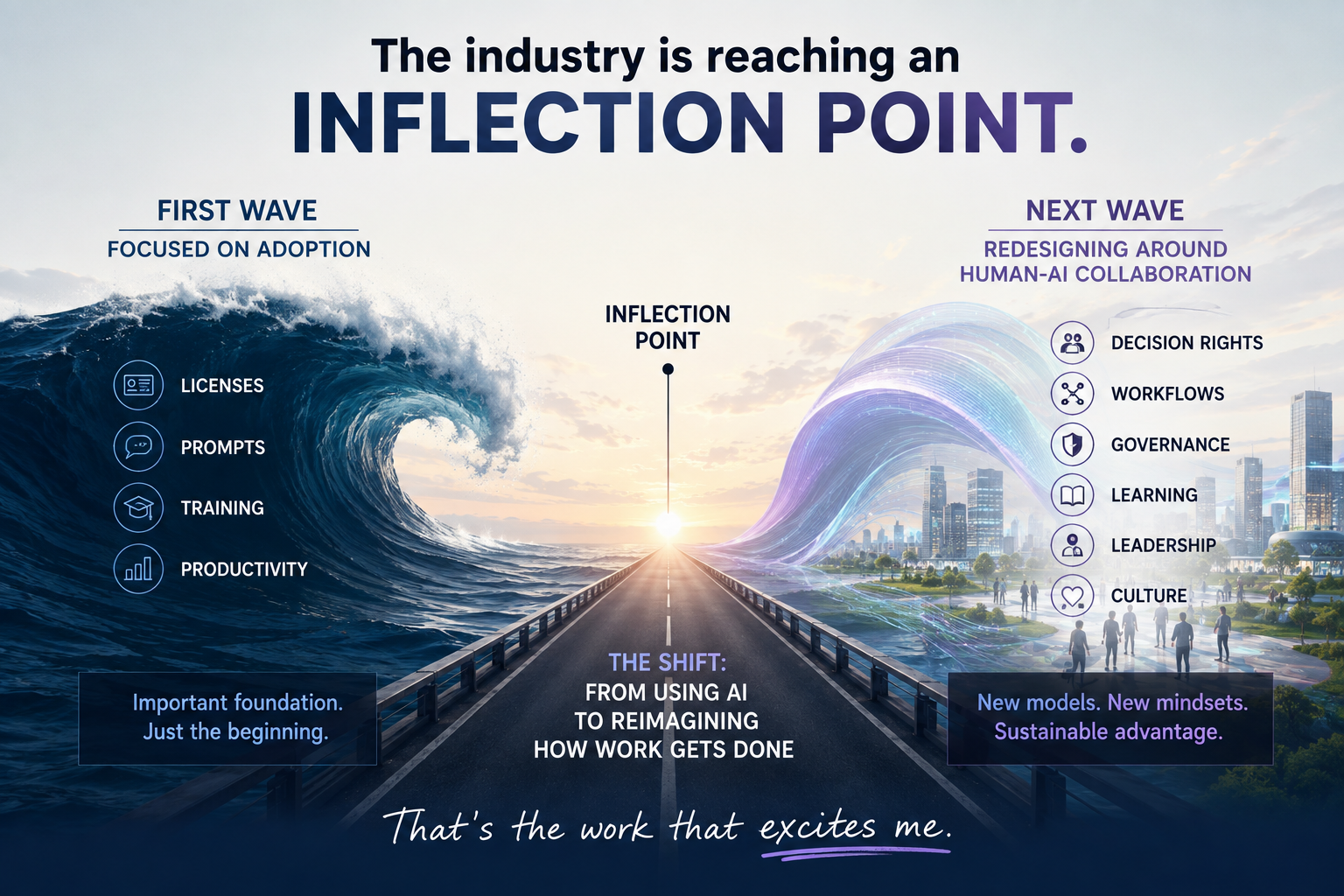
For the past two years, the conversation around AI has largely centered on adoption.
Organizations invested in licenses, prompt engineering, training programs, governance policies, and productivity gains. These investments were necessary. They helped employees become comfortable with AI and demonstrated that the technology could create measurable value.
But I believe the industry is reaching an inflection point.
The next wave of AI transformation is fundamentally different.
The conversation is no longer about helping people use AI. It is about redesigning organizations around human-AI collaboration.
That shift changes everything.
It challenges how decisions are made, how work flows across teams, how organizations learn, and how leaders create alignment in environments where humans and AI contribute together. It also raises important questions about governance, accountability, capability development, and culture.
We are already starting to see early examples of this shift in practice. Some financial institutions, for instance, are introducing AI systems that pre-screen credit risk and surface recommendations, while human underwriters retain final approval but focus only on edge cases and exceptions. In this model, decision rights are explicitly redesigned: AI handles the high-volume, low-variance decisions, while humans concentrate on judgment-heavy scenarios.
In product and engineering organizations, we are seeing teams restructure workflows so that AI agents generate initial code, test cases, and documentation, while engineers shift upstream into system design, architecture, and validation. The workflow is no longer linear—it is iterative and co-produced, with AI accelerating execution and humans anchoring quality and intent.
Even in customer operations, some companies are moving from traditional tiered support models to “AI-first triage” systems, where AI resolves routine inquiries end-to-end and escalates only complex or emotionally sensitive cases to human agents. This not only reduces cost-to-serve but also fundamentally changes the role of frontline teams toward higher-value problem solving and relationship management.
Technology is no longer the primary constraint.
Organizational design is.
The organizations that create lasting advantage will not necessarily be those with the most advanced AI models. They will be those that intentionally redesign their operating models so humans and AI complement one another in ways that improve decision quality, accelerate learning, strengthen innovation, and build trust.
This is where the people side of transformation becomes a strategic capability.
The future of AI transformation will require leaders to rethink:
● Decision rights between humans and AI
● End-to-end workflows and operating models
● Governance and responsible AI practices
● Learning ecosystems that evolve continuously
● Leadership capabilities for AI-native teams
● Organizational culture built on trust, adaptability, and collaboration
The first wave proved that AI can increase productivity.
The second wave will determine whether organizations can fundamentally transform how value is created.
That is the work that excites me.
Not implementing another technology.
Designing organizations where humans and AI can achieve outcomes that neither could accomplish alone.
Questions for Leaders
As we enter this next phase of AI transformation, I’m curious how others are thinking about these questions:
● Has your organization moved beyond AI adoption to redesigning how work gets done?
● What aspect of human-AI collaboration do you believe leaders are underestimating?
● Which operating model changes will create the greatest competitive advantage over the next five years?
● What capabilities will distinguish truly AI-native organizations from those simply deploying AI tools?
I believe the next competitive advantage won’t come from AI alone.
It will come from organizations that learn how to redesign work, leadership, and culture around effective human-AI collaboration.


