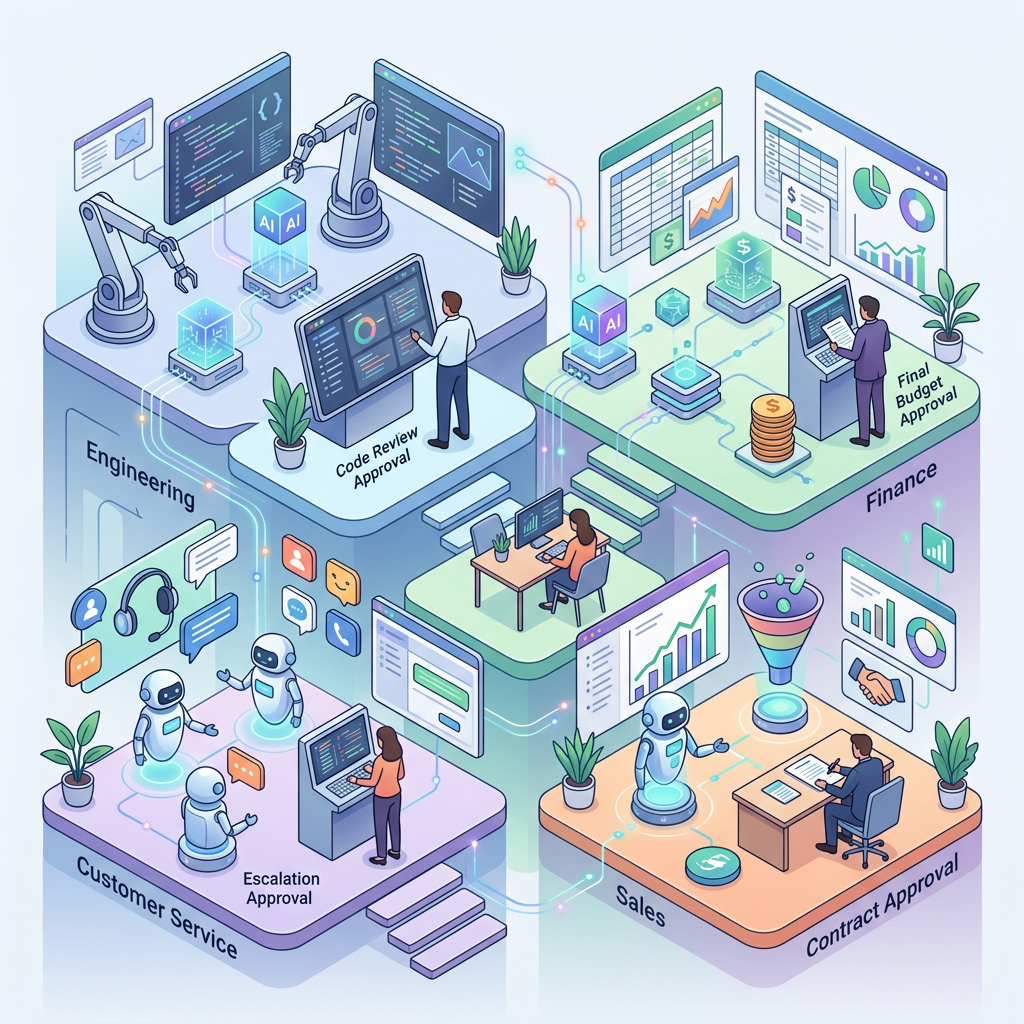
As AI gains more capability and autonomy, the limiting factor increasingly becomes human behavioral readiness: can leaders and teams adapt how they decide, collaborate, trust, learn, and remain accountable?
For the last several years, much of the conversation around AI transformation has focused on technology.
- Which model should we use?
- Which platform should we buy?
- Which workflows can we automate?
- How quickly can we deploy Copilot, agents, or other AI capabilities?
Those questions still matter.
But a different challenge is beginning to emerge.
As AI becomes capable of reasoning, retrieving organizational knowledge, interacting with enterprise systems, and taking increasingly autonomous actions, the transformation problem moves beyond technology adoption.
It becomes a human development problem.
Leaders now have to answer questions that are surprisingly personal:
- What should I continue deciding myself?
- What am I comfortable delegating to AI?
- How much should I trust an AI recommendation?
- When do I intervene?
- If AI performs part of my role, what becomes uniquely valuable about my contribution?
- And when something goes wrong, who is accountable?
These are not simply technology questions.
They are questions about identity, judgment, trust, behavior, responsibility, and leadership maturity.
Scenario 1: The Leader Who Has Always Been the Expert
Imagine a senior leader who has spent twenty years becoming the person everyone turns to for answers.
Her expertise created credibility.
Her ability to synthesize information quickly helped her rise through the organization.
Now her team has access to AI that can analyze large amounts of information in seconds, generate recommendations, compare scenarios, and prepare executive summaries.
Suddenly, being the person who knows the most is no longer the only source of leadership value.
That creates an identity shift.
The leader’s value increasingly moves from:
Knowing the answer
to
framing the right problem, questioning the answer, applying context, making judgment calls, and helping others make sense of uncertainty.
That requires a very different kind of confidence.
Scenario 2: The Manager Who Receives an AI Recommendation
Imagine a customer-service leader receives an AI-generated recommendation:
Approve this customer exception.
The recommendation appears logical.
The data supports it.
The AI has reviewed dozens of similar cases.
What should the manager do?
Approve automatically?
Review every recommendation?
Only review high-risk cases?
What happens when AI has historically been right 98% of the time?
This is where leadership moves from simply trusting technology to developing trust calibration.
Good leadership will not mean trusting AI more.
It will mean knowing when to trust, when to verify, and when human judgment must override the system.
Scenario 3: The Employee Whose Work Has Changed Overnight
Consider a knowledge worker who spends 40% of the week researching information, preparing reports, documenting meetings, and synthesizing data.
An AI agent can suddenly perform much of that work.
From a productivity perspective, this sounds fantastic.
From a human perspective, another question appears:
If AI can do a large portion of what made me valuable yesterday, what makes me valuable tomorrow?
Organizations can easily interpret resistance as an adoption problem.
But underneath resistance may be something deeper:
Loss of identity.
Fear of becoming irrelevant.
Uncertainty about career progression.
Loss of perceived expertise.
Concern about status.
Leaders who ignore these psychological dynamics may have excellent AI technology and disappointing transformation outcomes.
Workforce readiness therefore cannot simply mean:
“Can employees use the new tool?”
It must increasingly mean:
“Can employees understand how their role is evolving and where their human capability becomes more valuable?”
Scenario 4: The Team That Starts Moving Faster Than It Thinks
AI dramatically accelerates work.
Research that once required hours may take minutes.
Documents can be generated instantly.
Recommendations can appear before a leadership meeting begins.
Decisions can move faster.
But speed creates its own leadership risk.
When organizations become able to generate answers faster, leaders must become even better at asking:
Is this the right question?
What assumptions produced this recommendation?
What information might be missing?
Who could be affected?
What happens if this decision is wrong?
Some of the most valuable leadership behaviors in an AI-enabled organization may therefore look surprisingly slow.
Reflection.
Discernment.
Challenge.
Dialogue.
Ethical reasoning.
The goal is not simply faster decision-making.
It is higher-quality decision-making at greater speed.
Scenario 5: The Agent That Can Actually Take Action
Now imagine AI moves beyond recommendations.
An engineering agent can analyze an incident.
Access systems.
Create tickets.
Recommend remediation.
Potentially initiate actions.
A finance agent can investigate exceptions.
A customer-service agent can resolve cases.
A sales agent can prepare proposals and update CRM records.
At this point, AI is no longer simply a productivity assistant.
It is becoming a participant in the operating model.
And leadership must answer:
- Where should AI act?
- Where should humans approve?
- Where must humans remain responsible?
This is where technology architecture and leadership architecture meet.


