Beyond AI adoption: Consciousness, organizational psychology, human judgment, and the future of work
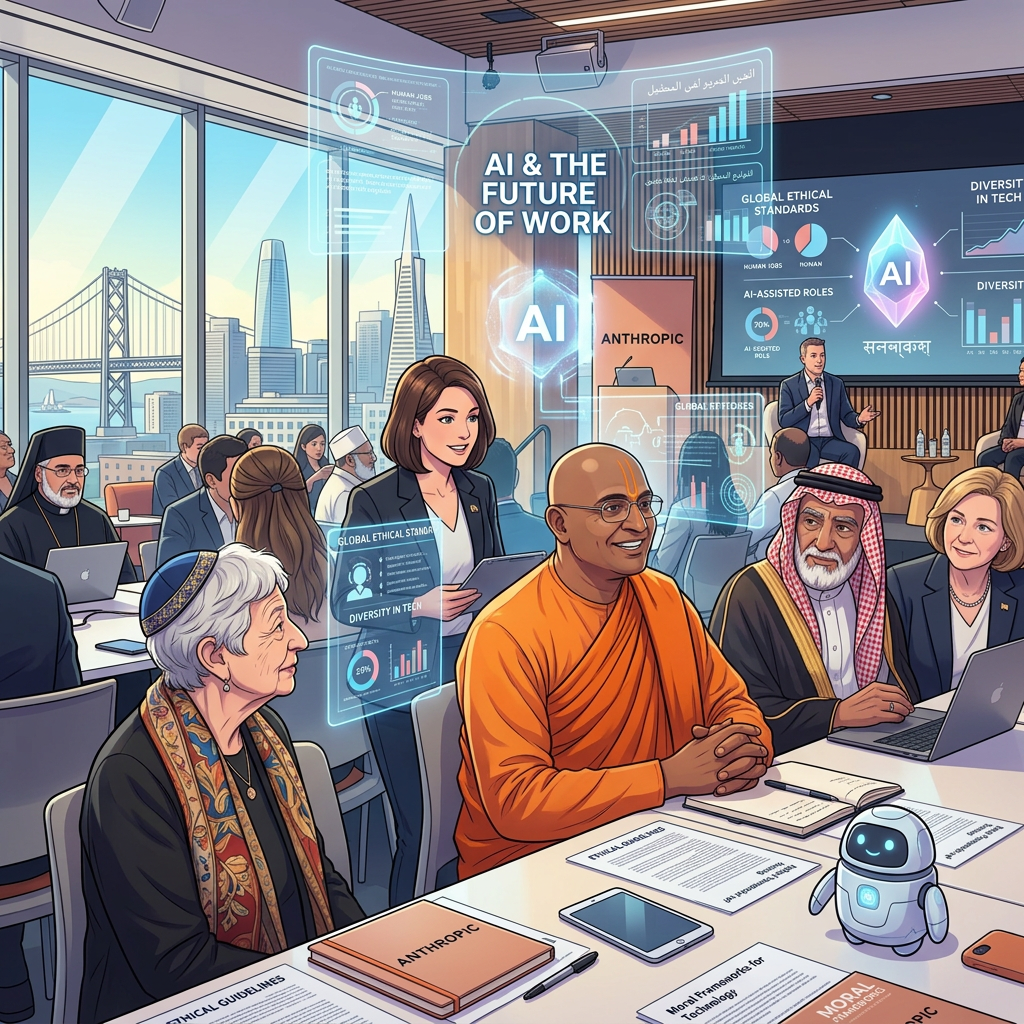
What happens when one of the world’s leading AI companies turns to a Vedantic monk to explore the ethical development of artificial intelligence?
That question captured my attention while listening to Swami Sarvapriyananda’s recent conversation with NDTV about his engagement with researchers at Anthropic, the company behind Claude.
The conversation brings together two seemingly distant worlds: frontier artificial intelligence and the ancient philosophical traditions of Vedanta.
Yet the deeper connection is highly relevant to business transformation.
As organizations race to implement generative AI and autonomous agents, we must ask a question that goes beyond technological capability:
Are we transforming our organizations to become more intelligent, or are we helping human beings become more conscious, capable, and responsible in how they use intelligence?
I believe the distinction matters.
1. Intelligence and consciousness are not the same
One of the central ideas in Swami Sarvapriyananda’s discussion is the Vedantic distinction between Buddhi (intellect or discriminative intelligence) and Chaitanya (consciousness).
Modern AI systems can process information, generate sophisticated reasoning, recognize patterns, and support increasingly complex decisions.
But intelligence, however advanced, does not automatically establish subjective awareness or consciousness.
Whether artificial intelligence could ever be conscious remains an open philosophical and scientific question.
For organizational leaders, however, the immediate implication is practical.
An AI system may produce an excellent recommendation. That does not eliminate the need for human accountability, contextual understanding, or ethical judgment.
The challenge is not simply to make AI more intelligent.
It is to ensure that the humans and institutions deploying it become more discerning.
2. From AI adoption to human–AI operating model transformation
For years, enterprise change management has focused on technology adoption: awareness, readiness, communications, training, engagement, and usage.
These capabilities remain essential.
But frontier AI introduces a more fundamental challenge.
AI is no longer confined to helping employees complete individual tasks. Increasingly, AI agents can participate in workflows, initiate actions, coordinate activities, and influence decisions.
That changes the organizational operating model.
Consider what must now be redesigned:
- Decision rights: Which decisions can AI recommend, execute, or escalate?
- Accountability: Who remains responsible when an AI-assisted decision causes harm?
- Workflows: Where should human judgment enter the process?
- Roles: How do jobs evolve when routine cognitive tasks become automated?
- Governance: How are organizational values translated into enforceable controls?
- Learning: How do employees preserve expertise while increasingly relying on AI?
These are not merely IT implementation questions.
They are questions of organizational design, leadership, psychology, and behavioral change.
The next frontier of organizational change management is therefore not just AI adoption.
It is human–AI collaboration by design.
3. Psychological safety is essential to responsible AI adoption
One of the risks of highly capable AI is that people may begin to trust its outputs more than their own judgment.
A confident AI-generated response can appear authoritative even when it is incomplete or incorrect.
At the same time, employees may feel pressured to demonstrate enthusiasm for AI, even when they have legitimate concerns.
This creates a dangerous organizational dynamic.
People may stop questioning the technology because they fear being labeled resistant to change.
Responsible AI transformation requires the opposite.
Employees must feel psychologically safe to say:
“This recommendation doesn’t look right.”
“I don’t understand how this conclusion was reached.”
“I believe this decision requires human review.”
“We need to reconsider this workflow.”
Psychological safety should not be treated as a soft cultural benefit.
It is an operational capability that supports better decisions, earlier risk detection, and responsible AI governance.
Organizations should measure not only AI usage, but also the quality of human oversight and employees’ willingness to challenge automated outputs.
4. The organizational psychology of human–AI collaboration
As AI becomes embedded in daily work, organizations must understand how it changes human behavior.
Several psychological dynamics deserve attention.
Automation bias: People may accept AI recommendations without sufficient independent verification.
Cognitive offloading: Employees may delegate so much thinking to AI that their own analytical capabilities weaken.
Identity disruption: Professionals whose expertise has defined their careers may struggle when AI performs parts of their work.
Loss of agency: Employees may feel that algorithms increasingly determine their work, performance, and professional future.
Anthropomorphism: People may interpret human-like AI language as evidence of understanding, empathy, or authority.
These challenges cannot be resolved through prompt-engineering workshops alone.
They require intentional behavioral design, leadership engagement, role clarity, meaningful participation, and continuous learning.
The objective should not be to create employees who depend on AI for every answer.
It should be to develop professionals who know when to use AI, when to question it, and when human judgment must prevail.
5. What Vedantic wisdom can contribute to modern leadership
Vedanta offers a philosophical framework for examining the relationship between awareness, perception, thought, judgment, and action.
It invites us to observe our mental patterns rather than automatically identify with them.
This perspective can inspire a valuable leadership practice: creating space between information and reaction.
Imagine a leader receiving an AI-generated recommendation during a high-pressure organizational decision.
A reactive leader might accept the recommendation immediately because it appears efficient and authoritative.
A reflective leader might ask:
What assumptions are shaping this recommendation?
What information is missing?
Who could be affected?
What biases—human or algorithmic—might be influencing the outcome?
Does this decision align with our responsibilities and values?
This is where the Vedantic principle of Viveka, or discernment, becomes a useful metaphor for leadership.
It does not replace scientific evidence, governance standards, or technical validation.
Rather, it reminds us that sophisticated intelligence must be accompanied by careful judgment.
6. Five capabilities for the next generation of AI transformation leaders
I believe organizations should begin developing five interconnected capabilities:
- Human–AI collaboration design:
- Conscious decision-making
- Psychological safety and trust calibration
- Adaptive operating models
- Human Centered Value Realization
Measure business productivity alongside decision quality, employee agency, workforce capability, and stakeholder trust. These capabilities represent an opportunity for organizational change management to evolve into a strategic discipline shaping how humans and intelligent systems create value together.
7. The future of leadership is not a competition with AI
One of the most compelling messages in Swami Sarvapriyananda’s conversation is his encouragement to young people to embrace AI while cultivating their spiritual selves through service, devotion, meditation, and self-inquiry.
I interpret this as a powerful message for enterprise leaders.
We do not need to reject AI to preserve our humanity.
Nor should we surrender human judgment in pursuit of efficiency.
We need to become more intentional about the relationship between technology and human development.
As AI becomes more capable, our responsibility to design humane institutions becomes greater.
The future of leadership will not be defined solely by the smartest AI, but by the depth of human awareness, wisdom, and responsibility guiding it.
That is the transformation opportunity before us.
Not simply creating AI-powered organizations.
But creating organizations where human intelligence, ethical judgment, and artificial intelligence can collaborate to generate sustainable value.
A question for organizational leaders and change practitioners:
As your organization advances from AI adoption toward agentic AI and autonomous workflows, are you redesigning only the technology—or are you also redesigning the human operating model?
I’d welcome perspectives from leaders working at the intersection of AI, organizational psychology, human-centered transformation, and responsible innovation.
Inspired by Swami Sarvapriyananda’s conversation with NDTV at the 2026 World Summit.
Watch the conversation: https://youtu.be/WHg6bUbmab4
#AITransformation #OrganizationalChangeManagement #ConsciousLeadership #HumanAICollaboration #Vedanta #FutureOfWork #SwamiSarvapriyananda


