Microsoft AI’s vision of “humanist superintelligence” is a north star. Here is how leaders turn it into measurable wins, starting this quarter.
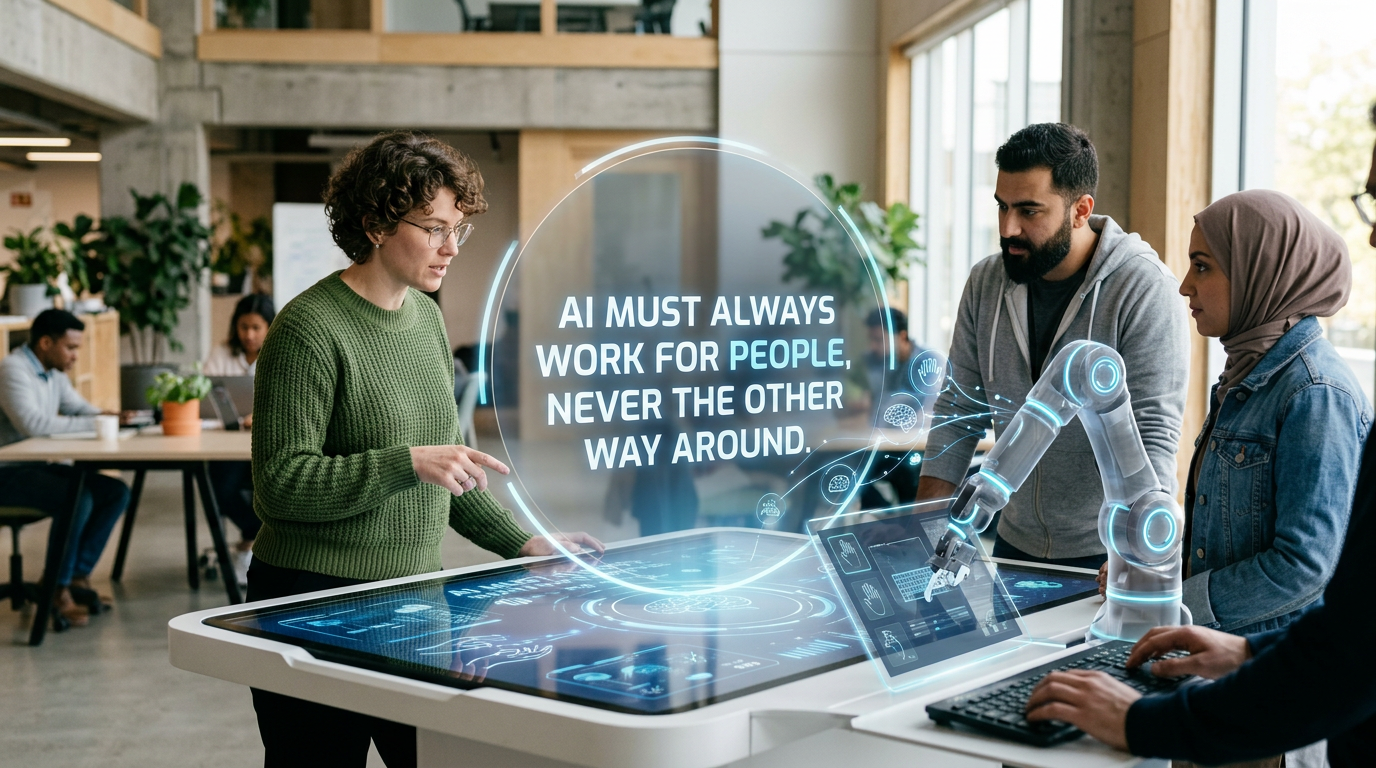
Mustafa Suleyman, CEO of Microsoft AI, has a clear conviction: AI must always work for people, never the other way around. In his recent conversation with historian Yuval Noah Harari (video), that conviction was front and center. Microsoft has also put it into strategy. In November 2025 it formed the MAI Superintelligence Team to build humanist superintelligence: advanced AI designed to stay controllable, aligned and in service of humanity.
Harari offers the counterweight. He warns that AI is the first technology that can make decisions on its own. That is exactly why leadership, not luck, has to set the rules.
My view, after 15+ years leading, partnering and supporting enterprise transformation, is optimistic. We are on the eve of abundance. Whether we get there depends less on the models than on our leadership, our culture and the outcomes we choose to measure. Here are five shifts for leaders building AI-native organizations, especially the non-AI-native ones that make up most of the economy.
1. Treat containment as your license to scale
Suleyman has long argued that AI’s benefits depend on two things: containment (keeping powerful systems within limits we set) and alignment (making sure they pursue what we actually intend). Microsoft’s humanist superintelligence manifesto commits to real restrictions on autonomy, keeping humans in the driving seat.
Inside your organization, these frontier-lab problems are already showing up:
- Autonomy creep: agents that send, approve or change records with no human checkpoint.
- Goal misspecification: an agent that “reduces the backlog” by closing tickets, not resolving them.
- Seemingly conscious AI: a warm, fluent assistant that people trust more than they verify.
The leaders who move fastest will be the ones who govern best. Containment is not the brake on innovation. It is the license to scale it.
Where you’ll see it this quarter:
- Security is asking who owns the Copilot Studio agents that business units built over the summer.
- An agent is ready to go live, but nobody has agreed which actions need human approval.
- Legal and compliance review AI one use case at a time, and the queue keeps growing.
2. Turn the paradox of abundance into a people strategy
If AI writes, plans and creates, where do motivation, mastery and meaning come from? It is a fair worry. My answer: abundance in one dimension frees attention for another. When routine cognitive work becomes cheap, judgment, creativity, relationships and wisdom become the scarce and valuable assets. Those are deeply human.
AI-native organizations resolve the paradox by design. They decide on purpose where reclaimed time goes. They measure wellbeing next to productivity. They make reflection a leadership practice, not a perk.
Where you’ll see it this quarter:
- Copilot licenses are deployed, but usage has flattened since the launch buzz.
- Managers can’t say where the hours saved actually went.
- Early-career staff are producing more but learning less, and their leads have noticed.
3. Position AI as glasses, mirror, calculator and thinking partner
The healthiest AI-native cultures share a simple mental model. AI is glasses that help us see patterns we would miss. It is a mirror that reflects and challenges our thinking. It is a calculator that carries the heavy lifting of drafting and analysis. And it is a thinking partner for ideas we would not reach alone.
This framing is a design choice, not an assumption. Humans own the decision, the accountability and the final word. AI earns trust through transparency and evaluation, never through fluency alone.
It also starts with shared language. Suleyman draws a line every team should understand: intelligence is the ability to use and generate knowledge to deliver practical outcomes; consciousness is the lived experience of a being that can suffer. Today’s AI has the first, with no evidence of the second. Building systems that merely seem conscious, he argues, is exactly what the industry should avoid.
Where you’ll see it this quarter:
- Some teams won’t touch AI, while others paste its output into customer emails without review.
- Your AI policy says what is forbidden, but not how to work well with it.
4. Lead with a new humanist narrative
People cooperate at scale through shared stories, and the story we tell about AI shapes what we build. The story I want leaders to tell has three threads. First, an expanding circle of empathy and trust, reaching future generations and the planet itself. Second, evidence over authority: AI accelerates the scientific loop of hypothesis, experiment and measurement. Third, kindness as an operating principle, encoded into how agents behave and how success is measured.
Technology amplifies whatever story we feed it. Let us feed it one of shared flourishing.
Where you’ll see it this quarter:
- Your AI town hall raised more anxiety about jobs than excitement about the future.
- Your company values say nothing yet about how AI should treat customers and employees.
5. Make humanist superintelligence measurable
This is where vision becomes value. Microsoft’s first humanist superintelligence focus areas are AI companions, medical superintelligence and clean energy. The early evidence is striking:
- In a peer-reviewed Science study, Microsoft’s diagnostic orchestrator correctly diagnosed 83.2% of 304 complex cases, versus 36.1% for generalist physicians. Real-world clinical proof is still to come.
- Dragon Copilot users report saving about five minutes per patient encounter, and 70% report less burnout.
The breakthroughs will take years. Your first wins should take 90 days. In my work, five principles separate pilots that stall from programs that scale:
- Start with suffering, not software. Every use case names a human who benefits.
- Baseline before you build. No “before” number, no evidence.
- Human in the loop by default. Containment, made practical.
- Invest in people as much as platforms. Adoption, not licensing, is where value is realized.
- Ship in 90-day cycles with the partner ecosystem. Prove value fast, then report it openly.
Three starter projects show what this looks like on the Microsoft stack:
| Project | Microsoft technology | Headline metric |
|---|---|---|
| Clinician time-back | Dragon Copilot | Documentation minutes per encounter |
| Frontline knowledge companion | Copilot Studio + SharePoint | Time-to-answer for field and frontline staff |
| Wellbeing-aware productivity | Microsoft 365 Copilot + Viva Insights | After-hours work hours per week |
Each comes with a fuller scorecard, a change plan and governance guardrails. That is the part worth designing with your teams, not copying from a blog.
Where you’ll see it this quarter:
- The steering committee asks for AI ROI, and the best answer so far is anecdotes.
- You have a dozen pilots and no agreed criteria for which ones scale.
- The platform team owns deployment, but nobody clearly owns adoption.
The invitation
The frontier labs will keep pushing capability. The real test of humanist AI will happen inside hospitals, public agencies, nonprofits, manufacturers and service firms. Their leaders will decide whether AI makes work more humane.
If you saw your own roadmap in any of these lists, you are not behind. You are where most organizations are right now, and every one of these is a solvable change and adoption problem.
Helping organizations make this shift is the work I care about most, whether as a trusted advisor, a hands-on transformation partner or a leader inside the team. If you are building an AI-native organization on the Microsoft ecosystem and want to compare notes on adoption, change and measurable impact, let’s connect.


